
- Release date: September 19, 1984
- Director: Milos Forman
- Starring: F. Murray Abraham, Tom Hulce
- Genre: Historical Drama, Comedy
- Star rating: 8.5/10
“Sire, only opera can do this. In a play if more than one person speaks at the same time, it’s just noise, no one can understand a word. But with opera, with music… with music you can have twenty individuals all talking at the same time, and it’s not noise, it’s a perfect harmony!”
Wolfgang Amadeus Mozart
Two simplistic tunes played on the piano.
The boasting of over 40 operas.
The reminiscence of a majestic bygone era.
Such words are uttered by a frail Antonio Salieri yet they are all obscure to the visiting priest, but all it took to recognize his long-departed rival was the ease of remembering the jovial G-Major melody of Eine kleine Nachtmusik. With this example of sonic immortality comes the tragedy of Amadeus (1984) which orchestrates its characters’ dynamism and synchronicity redolent of the famed Viennese operas: a landslide of whimsical and strenuous emotions displayed in theatrical brilliance.
From the opening dialogue onwards, each measure ensures the initial dichotomy of its key figures with both blatant demeanor and subtle design that either way invites the audience with appreciative curiosity and compelling sympathy. Salieri is one who easily blends in the milieu, as he resides in comfortable luxury and in servitude to aristocratic rule, yet for such a conformist character, his envy for someone greater and his passionate petition for divine empowerment make him more humanly flawed than most beings onscreen. Mozart, by contrast, embraces his comical vulgarity and the scintillating audacity of his musical genius, yet the gravitas of his character lies on his misfortunes rooted in his carelessness and excessive passion for his reputable profession.

“Forgive me, Majesty. I’m a vulgar man. But I assure you, my music is not.”
Wolfgang Amadeus Mozart
But underneath the distinctions lies an understated similarity between the two that, for the most part, is masked by Salieri’s dualistic nature of his narration. For someone who holds much contempt for the prodigy, Salieri secretly had great admiration for him. In fact, he may be the only one who could comprehend the ingenious Amadeus, and as such, therein lies a point of unison: their virtuoso in musicality, cinematically ingrained from dialogue to score, that presents music as not merely a precise arrangement of notes, but a sonic translation of the state of mind.
Where Mozart constructs his pieces like an elaborate architect, Salieri interprets its structure with poetic grandiloquence. While Salieri hears a cavalcade of strings and voices as he becomes overwhelmed by Mozart’s drafts, Mozart’s fears and desperation are reflected in his own compositions as the D Minor chord of Don Giovanni plays at the arrival of his disciplinarian patriarch or the overbearing demands of a dark-cloaked stranger. However, no scene reflects this poignant, sonic synchronicity than Mozart’s final night composing Requiem in D Minor with the helping hand of Salieri, a pinnacle of mutual understanding between God-given and human skills.

“I heard the music of true forgiveness filling the theater, conferring on all who sat there, perfect absolution. God was singing through this little man to all the world, unstoppable, making my defeat more bitter with every passing bar.”
Antonio Salieri
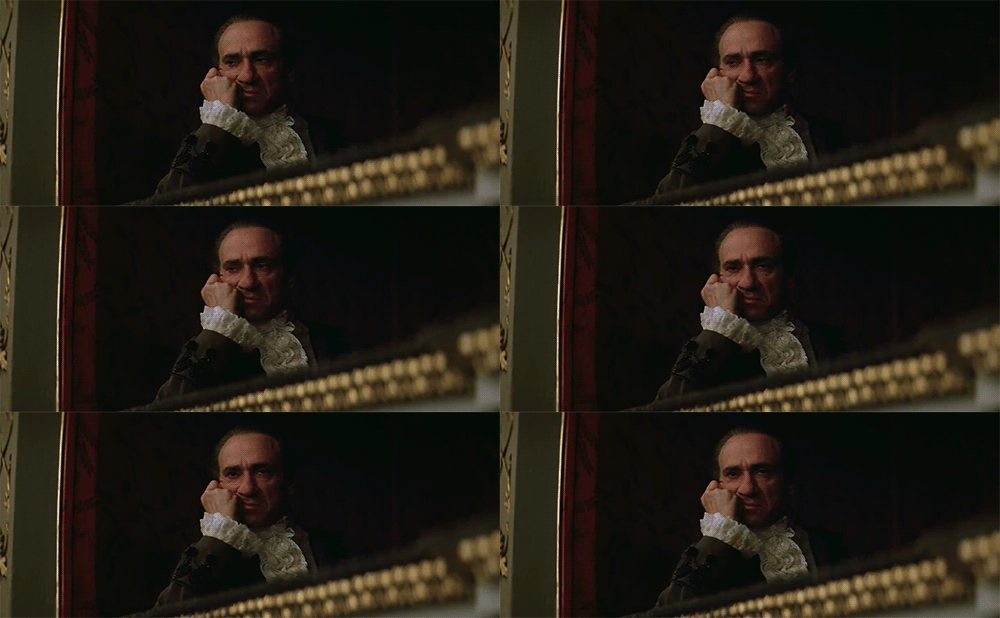
Though, it is quite ironic (maybe cruelly ironic) that their fates too come in harmony like chords: their faces showing signs of a languished soul rooted in their shared overt passions that gave them life. Their roads diverge, yet they meet at the crossroad of the same destiny. Their lives are relative in key, but they share the same signature of vain and ego.
Thus, Amadeus introduces itself as a sort-of reckoning of the spiteful and the decadent, then gradually composes itself into a rhetoric on talent’s true purpose and worth.
Is it really for fervent worship to the Almighty or to the innate spectacularism of the self?
Is the greatness of one’s gift measured by God’s selectivity or by mere human paradigm?
Does the superiority of one really equate to the inferiority of another’s own?
“I will speak for you, father. I speak for all mediocrities in the world. I am their champion. I am the patron’s saint.”
Antonio Salieri








 JMC - The Filmy Stan