Hollywood is witnessing a shift in its paradigm. With the rise of socio-political movements that push for more inclusivity and better representation, the Western entertainment industry is undergoing a reassessment of its milieu marred by a decades-long legacy of systemic exclusion and antiqued values. Thus far, the actions taken have made at least a dent in its barriers, but even minute steps have made noticeable changes in the cinematic landscape.
The nominees of this year’s Academy Awards, perhaps the most diverse in its history as of writing, greatly reflect this newfound progressive direction, with topical themes ranging from anti-racism, sexual violence, social injustice, and abject poverty, among others.
But whether the 93rd edition of the Oscars will only be temporary appeasement or a preview of a new norm remains to be seen. However, never has the “Oscar fever” felt so enticing as this edition in what is perhaps one of the most competitive and most unpredictable awards seasons in recent years.
Let us indulge in enthusiastic, Oscar-pundit analytics, shall we?
BEST SUPPORTING ACTRESS
Nominees
- Maria Bakalova – Borat Subsequent Moviefilm as Tutar Sagdiyev
- Glenn Close – Hillbilly Elegy as Bonnie “Mamaw” Vance
- Olivia Colman – The Father as Anne
- Amanda Seyfried – Mank as Marion Davies
- Youn Yuh-jung – Minari as Soon-ja
To say that this year’s primary frontrunners for the Best Supporting Actress category are interesting is an understatement. Not only do their respective arts are as contrasting as night and day, but the Academy’s mere recognition of them also best represent a Hollywood slowly opening its doors to talents not native to the American or British scene. Gradually fading are the days when the likes of Liv Ulmann and Fernanda Montenegro may never have a fighting chance to clinch that coveted statuette for the mere fact of being foreigners. Then again, 2021 might only be an exception.
On the one hand, we have Maria Bakalova. It is an open secret that the Academy has a clear-as-day bias for dramatic roles. For the awarding body to even give kudos, let alone attention, to the Bulgarian actress’ hilarious, improvised roleplay as the rambunctious daughter of the mischievous Kazakh reporter Borat is a rarity and a welcoming one at that.
On the other hand, we have Korean veteran actress Yuh-jong Youn in her bittersweet portrayal of an Asian family matriarch, with notable onscreen moments of hilarity and tragedy that show tangible proof of her expressive range. To Western eyes, she is a breakout star. To her compatriots, however, her talent comes as no surprise. She is, after all, “Korea’s Meryl Streep” for a reason.
By Academy standards, the latter might have the most apparent advantage; Youn has the acting style typically deemed as Oscar-worthy, the backing of a well-respected, independent film studio, and most importantly, victories in essential award season precursors (the SAG and BAFTAs). That said, Bakalova can still potentially steal Youn’s limelight, assuming that, for once, the Academy might opt for something deviant from the archetypical, award-winning acting.
But the combined presence of the two should not downplay the possibility of a darkhorse win from any of the two fellow nominees: Glenn Close and Amanda Seyfried, with the former having the perennial “long overdue for an Oscar” narrative by her side and the latter being the netizens’ most popular choice. If their campaigners play their cards right, popularity might be their secret weapon. But, as they remain empty-handed throughout the season thus far, the odds might not be in their favor.
- Prediction: Youn Yuh-Jung, Minari
- Personal choice: Maria Bakalova, Borat Subsequent Moviefilm
- Darkhorse: Glenn Close, Hillbilly Elegy and Amanda Seyfried, Mank
BEST SUPPORTING ACTOR
Nominees
- Sacha Baron Cohen – The Trial of the Chicago 7 as Abbie Hoffman
- Daniel Kaluuya – Judas and the Black Messiah as Fred Hampton
- Leslie Odom Jr. – One Night in Miami as Sam Cooke
- Paul Raci – Sound of Metal as Joe
- Lakeith Stanfield – Judas and the Black Messiah as William “Bill” O’Neal
Oh, Daniel Kaluuya and Lakeith Stanfield! If there were any justice in this world, they could have given Bozeman and company a run for their money. But stiff competition (which we will discuss later on) and “strategic” campaigning have sadly made them another casualty of questionable and perplexing categorization. Oh well. An Oscar is an Oscar, and fortunately for Kaluuya, a landslide victory is in order.
But if this year’s nominees for Best Supporting Actor reveal anything, it is the Academy’s perpetual preference for the biopic tropes. The objective is straightforward: get the character depiction right, and the Oscar is yours for the taking. The more accurate, the better.
Not to downplay the difficulty of achieving such a skill, but the near-ubiquity of such roles begs the question of whether they can still genuinely appeal. Yet, for all that is fair, it is impressive how the trend continues well into the 21st century.
Perhaps it is not just the accuracy that keeps the trope thriving today. It is the way the character captures the socio-political zeitgeist now, which firmly gives Daniel Kaluuya’s domineering portrayal of Black Panther leader Fred Hampton the upper hand. It checks the boxes of the winning formula: a performance full of vitality, a historical reflection of the times, and of course, the clear-cut favoritism from every essential awarding body (the SAG, Critics Choice, and BAFTAs).
However, there is one nominee with the potential to take the glory away from him. And it so happens that he is the outlier who does not rely on historical/biopic dramatics: Paul Raci. Heavily favored among most American critics circles, Raci’s performance grounds itself in an authentic and cathartic understanding of the deaf experience and is a quintessential example of minority representation. His nomination, let alone a potential victory, should prove seminal in this regard.
But, as mentioned from the beginning, it is Kaluuya’s Oscar to lose. But is there potential for an Alan Arkin-vs-Eddie Murphy scenario to reoccur? Perhaps.
- Prediction: Daniel Kaluuya, Judas and the Black Messiah
- Personal choice: Daniel Kaluuya, Judas and the Black Messiah or Paul Raci, Sound of Metal (had Daniel been a Best Actor nominee instead)
- Darkhorse: Paul Raci, Sound of Metal
BEST LEADING ACTRESS
Nominees
- Viola Davis – Ma Rainey’s Black Bottom as Ma Rainey
- Andra Day – The United States vs. Billie Holiday as Billie Holiday
- Vanessa Kirby – Pieces of a Woman as Martha Weiss
- Frances McDormand – Nomadland as Fern
- Carey Mulligan – Promising Young Woman as Cassandra Thomas
If the scarcity of opportunity for women in the film industry were a chronic disease, then the history of the Best Leading Actress category would be a glaring symptom. A revealing waterloo of the Academy Awards lies in the difficulty of even naming five nominees, not necessarily because it is hard to choose, but because they are hard to come by in a still largely patriarchal industry.
The year 2020, however, witnessed an optimistic turnaround for actresses. More compelling and timely female characters are in abundance, resulting in some of the most acclaimed performances of the year and, consequently, the most competitive Oscar race in any of the four acting categories this year.
Good news for the ladies, bad news for the bookies. The problem? No one pulled off a clean sweep, with each of the precursors yielding different winners at random.
Golden Globes? Andra Day.
Critics Choice? Carey Mulligan.
Screen Actors Guild? Viola Davis.
BAFTAs? Frances McDormand.
So, if neither performance quality nor awards dominance could determine the clear-cut winner, what will? Perhaps it is in their advantages and drawbacks.
First is Vanessa Kirby as a woman who suffered from depression following stillbirth in Pieces of a Woman. While her fellow nominees get one accolade a piece, she is unfortunately without a salient award to her name except for the Coppa Volpi. Ergo, she has the slightest precedence of an Oscar win. Ironically, though, the lack of one may also be her advantage, as the electorate may compassionately select her for that reason, opening a possibility for a darkhorse win a la Marcia Gay Harden.
Then, there’s Andra Day, who plays Billie Holiday in the biographical drama The United States-vs-Billie Holiday. While her unexpected win at the Golden Globes raises her prospects, her not getting a nomination at the Screen Actors Guild downgrades them too. Nonetheless, if Regina King can emerge victoriously in a similar circumstance just two years prior, so can Andra Day.
That leaves us with our three remaining nominees that arguably have the likeliest chances of clinching the golden man. How it plays out depends on how Academy members perceive the value of the Oscar.
If an Oscar represents the height of one’s career, then Viola Davis should have the edge. As one of the more decorated veterans, Davis has accumulated enough goodwill and respect among her peers (which could explain her SAG win) and splendidly plays a role that she knows best: a black woman of power as the film’s titular chanteuse character. In addition to the topical nature of Ma Rainey, there is historical precedence to her potential win: 19 years have come and gone since the sole woman of color, Halle Berry, won Best Actress. If there is a perfect way to culminate Viola’s impact and influence as an African American icon, an Oscar victory here is more than ideal.
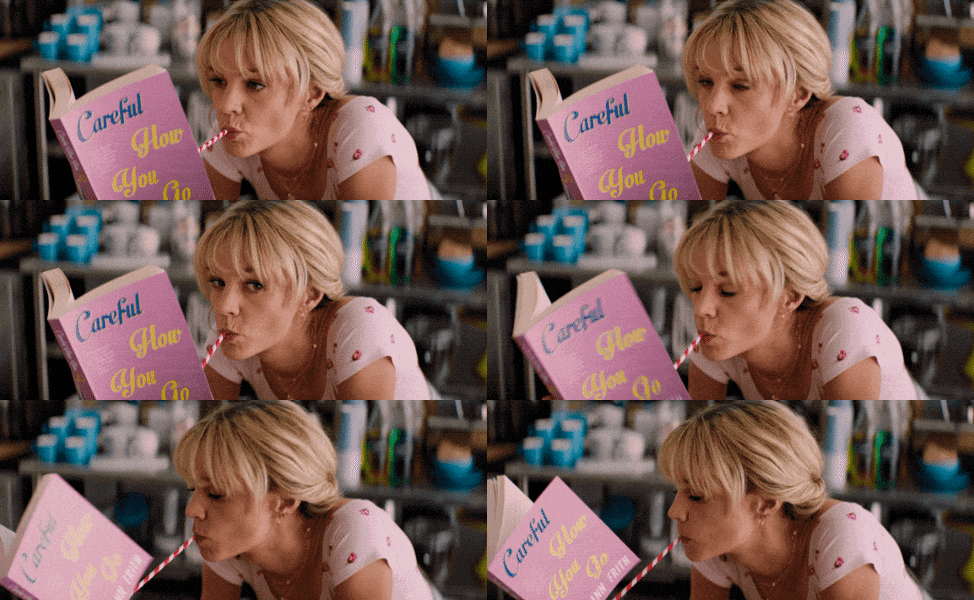
Conversely, if one merits the award through the critical popularity of specific performance, audiences may tell you it is Carey Mulligan and not without reason. Mulligan was able to elucidate all the women’s frustrations, trauma, and distrust against sexual offenders in the substantial character of Cassie in Promising Young Woman. If anything, her performance is arguably one of the less Oscar-bait of the five, barely relying on cliched tropes the Academy would typically adulate. Not to mention, she has the vote of the National Board of Review and the Critics Choice Awards to back.
But an ideal Oscar winner would encompass both qualities: the overwhelming favoritism of both veterans and novices as well as the critical appraisal of her performance. That nominee might be Frances McDormand, another seasoned actress numerous film critics circles favor the most this year. Often, de-glamming and dishevelment of oneself get actress merit, but McDormand is an exception; she is one of the antitheses of the Hollywood extravaganza, and her role as Fern in Nomadland is not only an apotheosis of her “no-fucks-given” persona but also a testament to her solidarity for the American nomads.
With that said, each of the three’s chances of winning has its hurdles that range from voting dynamics to individual preferences to even plain bad luck.
While Davis has the #BlackLivesMatter movement and the Academy’s diversity agenda behind her back, Andra Day, another fellow black nominee, also follows a similar narrative. Subsequently, a spoiler effect may happen, where votes that could have gone to one candidate went to the alternative instead. Ergo, a scenario of canceling out a la Geena Davis and Susan Sarandon in ’92 is not far-fetched.
For McDormand, she is at odds with history. Having already received Best Actress just three years ago, the Academy may find rewarding her again too soon. And while she has better chances of winning via Best Picture as one of Nomadland’s producers, it is rare but not impossible for women to clinch two Oscars in a single night.
That leaves Mulligan with perhaps the least obstructive barriers, though not by a long shot. While Promising Young Women’s topical #MeToo message could be its strong selling point, the divisiveness of such themes can also be its Achilles’ heel. Because if the cautionary tales of Glenn Close’s (Fatal Attraction) and Rosamond Pike’s (Gone Girl) losses foretell us, deviating from the archetype Best Actress roles is a gamble whose odds are dependent on the Academy’s receptiveness to it.
So, who will emerge victoriously? Frankly, we will never know right until Joaquin Phoenix opens that envelope to read the winner’s name.
To the nominees (and to bettors who shall lose pennies come April 25), to quote from the Hunger Games mantra, “may the odds be ever in your favor.”
- Prediction: Honestly, who knows?
- Personal choice: Carey Mulligan, Promising Young Woman
- Darkhorse: Well, everyone.
BEST LEADING ACTOR
Nominees
- Riz Ahmed – Sound of Metal as Ruben Stone
- Chadwick Boseman – Ma Rainey’s Black Bottom as Levee Green
- Anthony Hopkins – The Father as Anthony
- Gary Oldman – Mank as Herman J. Mankiewicz
- Steven Yeun – Minari as Jacob Yi
Peter Finch as Howard Beale and Heath Ledger as the Joker remain the only two posthumous Oscar-winning performances. In 2021, we may see a new addition to the list: Chadwick Boseman as Levee in Ma Rainey’s Black Bottom. Now, it seems disingenuous, if not condescending, to dismiss Boseman’s possible victory as nothing but a mere product of condolences from the Hollywood elite.
For if the Academy’s history tells us anything, it’s that, contrary to popular belief, Hollywood doesn’t manifest their pity in an Oscar as frequently as you might think. (Two-time posthumous nominee James Dean can wager on that).
Perhaps, it is best to look at this race sans Boseman’s untimely death by veering away from our current reality and hypothesizing another. And in this world, where the Black Panther actor is alive and kicking, he competes in a derby that may have been as tightly unpredictable as this year’s Best Actress race.
Here, in the most realistic sense, he faces two formidable challengers to the coveted Oscar: Riz Ahmed as the metal drummer-turned-deaf Ruben Stone in Sound of Metal and legendary Sir Anthony Hopkins as an elderly in a mentally senescent state in The Father.
Choosing the most committed and most spectacular performance of the three is excruciating.
Will you vote for the man who best encapsulates the enthusiasm and furiousness of aspiring African American artists in one character?
Will you choose the man who best portrayed not only the challenges of sudden auditory loss but also the five stages of grief?
Or, will you vote for the man who best depicts the palpable horrors of dementia with harrowing precision?
But one must remember that effort is not always enough. If the victories of Sandra Bullock and Denzel Washington tell us anything, two crucial factors often come into consideration: political context and name recognition. And Chadwick Boseman possesses both.
Unfortunate events plagued the year 2020; the murder of George Floyd and the protests and discourse that ensued was one of them. Boseman’s appearance as the downtrodden Levee could not come in better timing. Additionally, following the footsteps of Scarlett Johansson in Marriage Story and Jojo Rabbit of the previous year, Ma Rainey is the perfect platform to display his genuine acting capabilities to an audience that may only recognize him as King T’Challa of Wakanda in the Marvel Cinematic Universe.
But this is not to say that Hopkins does not possess his aids to his Oscar bid. His recent BAFTA win hints at Hopkins’ consolidation of the votes from his British peers, not to mention his legendary status, as the ticket. As for Ahmed, he finds favor in the numerous critics’ circles of America and Britain backing his movement and, like Hopkins, the British compatriots’ support.
The result is a potential photo finish that could have gone down to the last vote.
But now, we return to reality and promptly consider Bozeman’s death. Henceforth, a third, crucial factor determines this race: personal narratives matter. Does it undermine Chadwick’s efforts? No, far from it. Dead or alive, his status as an Oscar frontrunner will have probably remained significant, considering other facets aforementioned. But, had the Grim Reaper not come to his doorstep too soon, perhaps this could-have-been close race would have been far more exhilarating to follow.
- Prediction: Chadwick Boseman, Ma Rainey’s Black Bottom
- Personal choice: Chadwick Boseman, Ma Rainey’s Black Bottom, and Riz Ahmed, Sound of Metal (If ties are permitted)
- Darkhorse: Riz Ahmed, Sound of Metal and Anthony Hopkins, The Father
BEST DIRECTOR
Nominees
- Thomas Vinterberg – Another Round
- David Fincher – Mank
- Lee Isaac Chung – Minari
- Chloé Zhao – Nomadland
- Emerald Fennell – Promising Young Woman
Woe to David Fincher. It looks like one of Hollywood’s most respected directors might have to wait for a couple more years.
It’s Chloe Zhao’s Oscar.
That’s it.
It is a landslide victory.
- Prediction: Chloe Zhao, Nomadland
- Personal choice: Chloe Zhao, Nomadland
- Darkhorse: No one
BEST PICTURE
Nominees
- The Father
- Judas and the Black Messiah
- Mank
- Minari
- Nomadland
- Promising Young Woman
- Sound of Metal
- The Trial of the Chicago 7
Parasite’s Best Picture win remains one of the most warmly receptive wins in the Academy Awards’ history, debunking notions of the organization’s hesitance to give positive recognition to a foreign-language film. But the film would not come that far in a Westerner-dominated institution if it was not the quintessence of a Best Picture feature, with a spectacular director’s vision well-grounded by succinct scriptwriting and executed well by an intricate production and a consistent cast ensemble performance.
And on this basis lies the key to clinching the most prestigious award of the film industry: congregate votes by appealing to the four most vital factions of the Academy: the directors, the producers, the writers, and the actors (notwithstanding the studio’s campaigning efforts must also count, of course).
And in this edition’s election for the most well-crafted movie of the past year, three featured films possess the most realistic chances.
If the varying award shows this season prelude to a winner, then the picture that received the unanimous appraisal is Chloe Zhao’s Nomadland. Freshly filled with picturesque American views and timely but specific montages of poverty, Nomadland earns its praise by utilizing competently one of the cinema’s golden rules: show more, tell less.
Hence, its filmmakers raking their awards for directing, producing, and, to some extent, adaptive scriptwriting suggest a collective commendation among three of the four essential sects from the industry and, by extension, the Academy. Its wins in the Directors Guild and the Producers Guild are prime examples.
However, missing out on the Screen Actors Guild nomination, except for Frances McDormand’s for Best Actress, may suggest that it is not a film preferred by the performing community, although to be fair, Nomadland borders close to a one-woman show.
It is a particular genre of cinema, similar to Alfonso Cuaron’s Roma, that most Academy members and general audiences may not fancy. People at times want to see more of the characters onscreen than the film onscreen if that makes sense.
Important to remember is an ideology in film appreciation still looms large and (somewhat) true today: the purpose of a movie is to entertain and endear. Nomadland may or may not be that type of amusement, but its other competitors might.
Take, for instance, The Trial of the Chicago 7. Fueled by powerhouse performances of its cast and an equally energizing screenplay by writer extraordinaire Aaron Sorkin, this film empowers one’s fight for justice through the retelling of one of America’s most controversial trials.
Its win in the Best Cast Ensemble category in the SAG and the writing community’s reverence to Sorkin are promising indicators that both the writers’ and actors’ votes could propel it to the top prize. Further aiding its potential is its accessibility as a Netflix original, a determinant factor this year given how the pandemic restricted the opening of cinemas.
Conversely, Sorkin shockingly missing out on a Best Director nomination at the Oscars might suggest that the directing circle may not be that fond of him and his work. And critiques regarding its Oscar-bait qualities may not help its cause.
That leads us to the third film that may come close to pulling off an upset for Nomadland: the A24 production named Minari. Arguably, this Korean-American family drama ticks the boxes of the Best Picture-winning formula: dynamic cast performances, nostalgic directorial vision, a thematically humane script, and grassroots production values.
Favoritism across filmmaking factions is evident in its consistent nominations for directing, production, original screenplay writing, and cast ensemble. Granted that it has lost most of them, a total defeat for Minari may not be as likely as they may think. Now, just because it lost does not mean it lost by a wide margin. If they consolidate enough votes, the quirks of the preferential voting system might swing in their favor, replicating Moonlight‘s pleasant victory over heavy favorite La La Land.
So, while Zhao and company may feel assured, they may want to watch out for Sorkin and Chung sneaking in to surprise them.
- Prediction: Nomadland
- Personal choice: Nomadland or Minari
- Darkhorse: The Trial of the Chicago 7 or Minari
QUICK PREDICTIONS
BEST SCREENPLAYS
Winning one of the best screenplay awards, adapted or original, is essential: eight of the ten Best Picture winners also clinched one of the Best Screenplay Oscars. This year, the razor-sharp writing of Emerald Fennell’s Promising Young Woman may triumph over the palpitating pen game of Aaron Sorkin’s The Trial of the Chicago 7 (That alone is quite the achievement!), and it’s a grueling three-way battle between Zhao’s verisimilitudinous dialogues, Cohen’s quick witticisms, and Zeller’s stage-to-screen adaptability.
Original Screenplay
- Prediction: Promising Young Woman
- Personal choice: Promising Young Woman
- Darkhorse: The Trial of the Chicago 7
Adapted Screenplay
- Prediction: Nomadland
- Personal choice: Nomadland
- Darkhorse: The Father and Borat Subsequent Moviefilm
BEST ANIMATED FEATURE
Under normal conditions, to witness Disney/Pixar’s constant hogging of this award is bemoaning. Fortunately, Soul is another bedazzling piece courtesy of Pete Doctor that could have been a challenger to the Best Picture nod had the Academy’s live-action preferences did not get in the way.
Meanwhile, Wolfwalkers could have given Soul a competitor to be feared. But Disney has its “ways,” to put it subtly.
- Prediction: Soul
- Personal choice: Soul
- Darkhorse: Wolfwalkers
BEST SOUND
Sound of Metal would not become what it is if it wasn’t for its sonically immersive experience of hearing loss. However, Soul‘s ability to recreate the urban symphony of New York City comes pretty close.
- Prediction: Sound of Metal
- Personal choice: Sound of Metal
- Darkhorse: Soul
BEST ORIGINAL SCORE
It is funny how Trent Reznor is his own competition this year, literally. But his tense use of synth/electronica elements makes his musical interpretation of the afterlife in Soul a much more refreshing take from the traditional orchestral sounds that audiences may find all too familiar.
- Prediction: Soul
- Personal choice: Soul
- Darkhorse: Mank and Minari
BEST FILM EDITING
Ah, yes! Somehow, it is the one category that the Academy never gets right (*cough* Bohemian Rhapsody *cough*). It’s wishful thinking to witness either The Father‘s manipulative mind games or Sound of Metal‘s syncopation with the scenes and sound design or even the concise but meaty montaging of Promising Young Woman and Nomadland take home the title. But Trial‘s thrilling back-and-forth switching from court to flashbacks looks good enough.
- Prediction: The Trial of the Chicago 7
- Personal choice: The Father
- Darkhorse: Anyone
Photo credits to Variety.com and OSCAR®









 JMC - The Filmy Stan